PoC vs Prototype vs MVP: Which Is Best for Your Project?
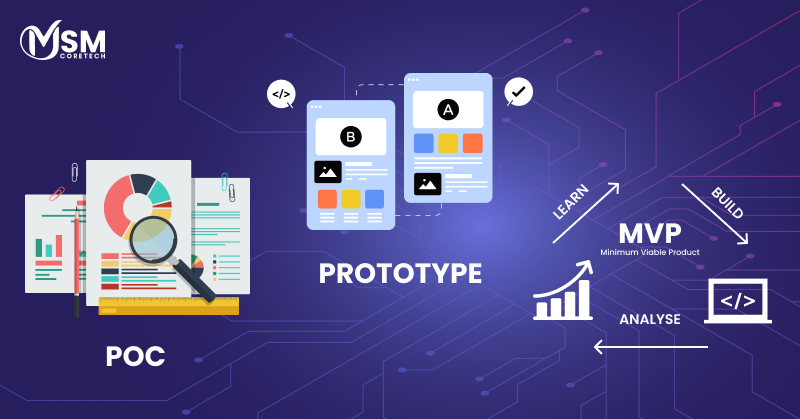
According to a recent market statistic, 34% of startups fail because their products are not a good fit for the market.
One of the most crucial terms in the marketing industry is PMF, or product-market fit. It listed the situations in which a product fulfills the needs of its intended market and its target audience while experiencing organic growth. To describe it in easy terms, if a particular product is liked and utilized, and eventually the demand for that is increased in the market, the company offering it achieves product-market fit. What differentiates successful startups from those that fail is PMF, which is frequently regarded as the turning point between struggle and scale. Business leaders can achieve product market fit through three confusing techniques.
- Proof of Concept (PoC)
- Prototype
- Minimum Viable Product (MVP)
The major misunderstanding regarding these three app viability check techniques is what makes them different from one another and which would bring them the closest to realizing the product market fit utopia before their rivals take action.
This assists you in picking the best course of action for achieving a product market fit in your app industry. This blog aims to clear up all the related queries.
But before you even reach that stage where you have to choose between a prototype, minimum viable product (MVP), or proof of concept (PoC), there are a few more questions you should have answers to:
- Who is your target audience going to be?
- What do you want to validate?
The Idea Behind: PoC vs Prototype vs MVP.
PoC (Proof of Concept)
PoC, also known as Proof of Concept, as the name suggests, is a technique used by different companies to confirm the viability of an idea. The stage is created well in advance of the starting point of the mobile app development process. While attempting to determine whether a concept can be achieved based on technical abilities or business model, a small part of the project is implemented in this stage. Since a mobile application’s proof of concept (PoC) is primarily intended to determine whether the idea is achievable, it is typically not displayed to the client or the general public or potential users.
Prototype
The one and only purpose of prototyping is to demonstrate how an application will appear to end users and flow from one screen to another. One of the most important steps in the app development process is creating a mobile app prototype. To learn how the app works, how easy it is to use, and what features need to be involved, it makes use of a wide variety of prototyping tools. If you want to raise funds from investors for your mobile app prototype, creating a prototype is very crucial.
MVP (Minimum Viable Product)
The major question is to define a minimum viable product (MVP). An MVP is a working application that has all of the important features that best describe the application. The MVP development process supports confirming the viability of the application, the team's presumptions regarding it, its likely usability, and the demand in the market. Building a minimum viable product eventually aids in the development of an application that is ready to collect feedback and reviews from the end users.

Select the Most Effective Strategy
The question of determining which strategy is the most effective is wrong in its own way.
Business leaders are able to decide between the strategies in order to actually achieve a product fit. Based on the stages of their application, they will either need to view the strategies as steps or select one of them.
Let’s dive into more details about each of the points.
Situation 1: When you have not yet reached the stage of idea validation
We consider this to be the ideal stage when you haven’t begun developing either of the strategies. This phase gives you the opportunity to map out the lifecycle of app validation.
There are many advantages to investing in a life cycle that begins with proof of concept and progresses through prototyping and MVP stages.
- Proper Concept Testing: The main purpose of developing an application, which starts with the proof of the concept stage and progresses to the prototyping and MVP stages, is to assist in determining whether the idea is viable. It assists business owners or entrepreneurs in modifying their original concept based on audience responses.
- Instant Development: If you hire Sumxinfotech, the best mobile app development company in Jaipur, you will be provided trusted features that can allow your brand to achieve better digital outcomes in a shorter time period.
- Minimized Risk of Investment: You can guarantee your investors that your app is free of risks and challenges, as it has gone through all three stages of testing. Therefore, you will end up getting more investments.
Situation 2: When you have reached the stage of idea validation
The situation is that when you have reached into the idea validation stage, there is very little chance that you will follow a detailed procedure to get to the product market fit phase. You will have to decide between POC, prototype, and MVP in this situation.
Additionally, the number will be based on many different variables, including sufficient to be transformed into “if this, then that” situations.
These are the following situations that will assist you to make your decisions:
Select PoC at the following times:
- When seed-stage funding is required.
- When you want to verify whether the concept is feasible, technically.
- When you want the team to share the internal knowledge.
- When evaluating the project’s or the features’ effectiveness.
Select Prototype at the following times:
- When you would like to see how the application actually works.
- When you want to show stakeholders the application but have limited funds and time.
- When technical availability is extremely restricted.
- When you require the app’s appearance and feel right away.
Select MVP at the following times:
- When you have to demonstrate a fully functional app to the client.
- When the application must generate revenue.
- When you require a bug-free application that can be accessible to everyone.
- When you require low-cost retention that is higher.
- When you want to modify the application and want to know how the market perceives it.
Different Opinions About PoC vs Prototype vs MVP
What differentiates an MVP from a Prototype?
The main distinction between an MVP and a prototype is that the minimum viable product or MVP is the latter version, which is an application that is ready for public release, while the prototype is the former version that is more of a stage intended to test the concept among a company’s internal stakeholders.
What differentiates a Prototype from a PoC (Proof of Concept)?
The terms “proof of concept” and “prototype” refer to two quite different ideas. A prototype is a clickable version of the software that allows stakeholders to see how a user would navigate through an application, while proof of concept (PoC) is just a collection of documents or simple software used to assess the viability of an idea.
What differentiates a PoC (Proof of Concept) from an MVP?
A concept and an application that are needed for retail or public release as compared in PoC vs. MVP. The concepts have the similar objective, which is to validate an app idea but they appear at quite different stages.
The initial step in idea validation is the proof of concept (PoC) approach, which includes implementing a small project to determine whether a concept can be implemented based on technical ability and different business model considerations.
On the contrary, the Minimum Viable Product (MVP) approach is a working application. This is the primary differentiation between MVP and PoC.
What should we think about while building an MVP application?
In some situations, the MVP development approach makes more sense than developing a proof of concept or prototype:
- When you need to demonstrate a fully functional application to the client.
- When you need to generate revenue out of your app.
- When you need an app that is bug-free and can be used by everyone.
- When low-cost retention is required.
- When you want to improve the app after knowing the user perception.
Conclusion
Developing a product is similar to experimenting with a goal in your head. The initial step in the procedure is laying the groundwork for the creation of a prototype and proof of concept, which are backed by MVP. We have attempted to blur the differentiation between the roles of PoC vs Prototype vs MVP in product validation, as was previously mentioned.
Your uncertainties regarding the idea’s viability are clarified by the proof of concept. A prototype removes any uncertainty regarding the product’s appearance and user experience. A minimum viable product also helps to get ongoing user feedback and reviews, which serve as the basis of the finished product.
To boost your chances of successful product development, you can select one or even all three. The MVP app development company can be contacted to begin the process of answering any typical questions you may have about PoC, prototype and MVP development services.

Related Blogs
Medical Software Development Guide: Everything You Need to Know
Discover all about medical software development—process, features, cost, and compliance for building secure, efficient, and reliable healthcare solutions.
Read More
Complete Travel App Development Guide for Modern Travel Businesses
Discover why travel businesses need a mobile app to increase bookings, improve customer engagement, offer personalized experiences, and stay competitive in the digital travel market.
Read More
Why Startups Should Invest in Mobile App Development?
In today’s digital-first world, mobile apps have become a powerful growth engine for startups. This blog explores why investing in mobile app development helps startups increase customer engagement, strengthen brand visibility, streamline operations, and scale faster. Learn how a well-designed mobile app can give startups a competitive edge, improve user experience, and drive long-term business success.
Read More
